Is Your Thyroid Medication Failing? Check Your Liver First
Published by HepatoBurn Endocrine Research Team | 8 Min Read
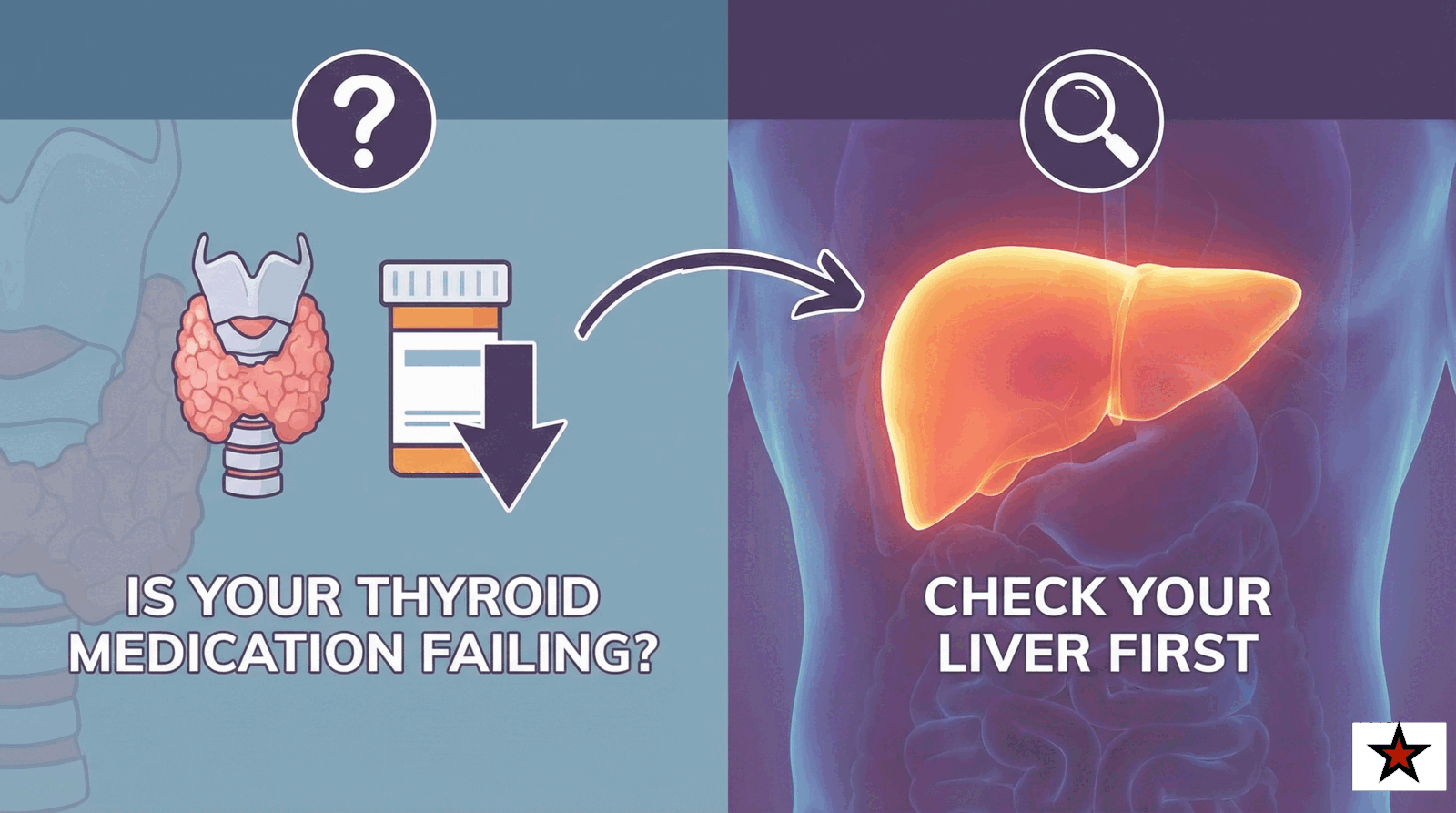
You did exactly what you were supposed to do. You felt constantly exhausted, your hair was thinning, and you couldn't stop gaining weight. You went to the doctor, they diagnosed you with a sluggish thyroid (hypothyroidism), and they handed you a prescription.
But months later, you are looking in the mirror feeling utterly defeated. You take your pill faithfully every morning, yet the scale hasn't moved an inch. Your belly is still bloated, and you still need a nap by 2:00 PM. Why isn't the medication working?
The shocking reality that most doctors fail to mention during a rushed 15-minute appointment is this: Your thyroid gland doesn't actually produce the hormone that burns fat. Your liver does.
The T4 to T3 Conversion Trap
Your thyroid gland (and most standard thyroid medications like Levothyroxine) produce a hormone called T4. But T4 is entirely dormant. It is inactive. To actually boost your metabolism and burn fat, your body must strip an iodine molecule off the T4 to convert it into T3 (the active, fat-burning hormone). Over 60% to 80% of this critical conversion happens directly inside your liver. If your liver is clogged with toxic sludge and inflamed, the conversion stops. Your blood tests will show you have plenty of thyroid medication in your system, but your cells are completely starving for the active energy.
Why Your Doctor's Blood Test Looks "Normal"
This is why you feel crazy when your doctor says, "Your thyroid levels look fine!" They are measuring the dormant T4 medication floating in your blood. They are rarely measuring the active T3 that your liver is supposed to be creating.
If you have a sluggish, fatty liver, taking more and more thyroid medication is like delivering piles of lumber to a construction site where all the workers have gone home. The materials are there, but the fat-burning house isn't getting built.
- Your thyroid labs are "normal," but you still suffer from severe hypothyroid symptoms.
- Your hands and feet are constantly cold, even indoors.
- You carry a thick layer of "hard" visceral fat directly under your ribcage.
- You experience severe constipation and chronic brain fog.
Signs Your Liver is Hijacking Your Thyroid:
Stop Wasting Your Medication
You cannot speed up your thyroid if the liver's conversion engine is broken. Discover the clinical protocol that power-washes the liver so your hormones can finally activate.
Watch the Liver-Thyroid Video →How HepatoBurn Unlocks Your Metabolism
If you want to actually feel the effects of a healthy thyroid, you must unclog the organ responsible for the T4-to-T3 conversion. You have to fix your liver.
This is the hidden reason why the HepatoBurn formula is generating such miraculous weight-loss stories for people with thyroid issues. It doesn't replace your medication; it repairs the biological environment so your natural (or prescribed) hormones can finally work.
- Silymarin Restores the Conversion Engine: The clinical-grade Silymarin in HepatoBurn actively dissolves the toxic sludge surrounding your liver cells. By clearing the cellular pathways, the liver regains its ability to seamlessly convert dormant T4 into active, fat-burning T3.
- Genistein Cools the Autoimmune Fire: Many thyroid issues (like Hashimoto's) are driven by inflammation. Genistein acts as a systemic fire-extinguisher, calming the liver and reducing the oxidative stress that halts hormone production.
- Resveratrol Amplifies the Burn: Once the active T3 is finally flowing through your bloodstream, Resveratrol steps in to activate the SIRT1 gene, accelerating the breakdown of the stubborn visceral belly fat that accumulated while your thyroid was stalled.
Reactivate Your Body Today
Don't spend another year feeling exhausted and heavy while your doctor simply adjusts your pill dosage. The bottleneck is not in your neck; it is in your abdomen.
By taking HepatoBurn every morning, you are giving your liver the exact Mediterranean botanicals required to repair its filtration system. Once the filter is clean, the dormant hormones activate, the "brain fog" lifts, and your body finally begins to shed the weight.
Fix the Conversion Blockage
Ensure your hormones can actually do their job. Click the secure button below to claim up to $900 OFF your 6-bottle supply of HepatoBurn today. Free shipping is automatically applied.
Claim Your Discounted HepatoBurn HereBacked by an iron-clad 60-Day, 100% Money-Back Guarantee.
Scientific References & Citations:
- Journal of Clinical Endocrinology & Metabolism: "Hepatic deiodination: The critical role of the liver in the conversion of Thyroxine (T4) to Triiodothyronine (T3)."
Proves that liver health dictates active thyroid hormone levels. - Thyroid Research Journal: "Non-alcoholic fatty liver disease (NAFLD) as a primary inhibitor of peripheral thyroid hormone metabolism."
Details how toxic sludge stops your medication from working. - International Journal of Molecular Sciences: "Silymarin's hepatoprotective effects and its influence on endocrine pathway restoration."